
Stainless Steel Pharmaceutical RO Plant – Industrial Reverse Osmosis Water Treatment Solution
A Stainless Steel Pharmaceutical RO Plant is an industrial water-treatment solution intended for projects where water quality, process consistency, hygienic design considerations and reliable operation are important. Pharmaceutical manufacturers and related facilities may require treated water for different manufacturing, cleaning, laboratory or utility applications. The correct treatment arrangement depends on the intended water grade, the quality of the incoming feed water, the required daily production volume and the applicable quality-management requirements of the facility.
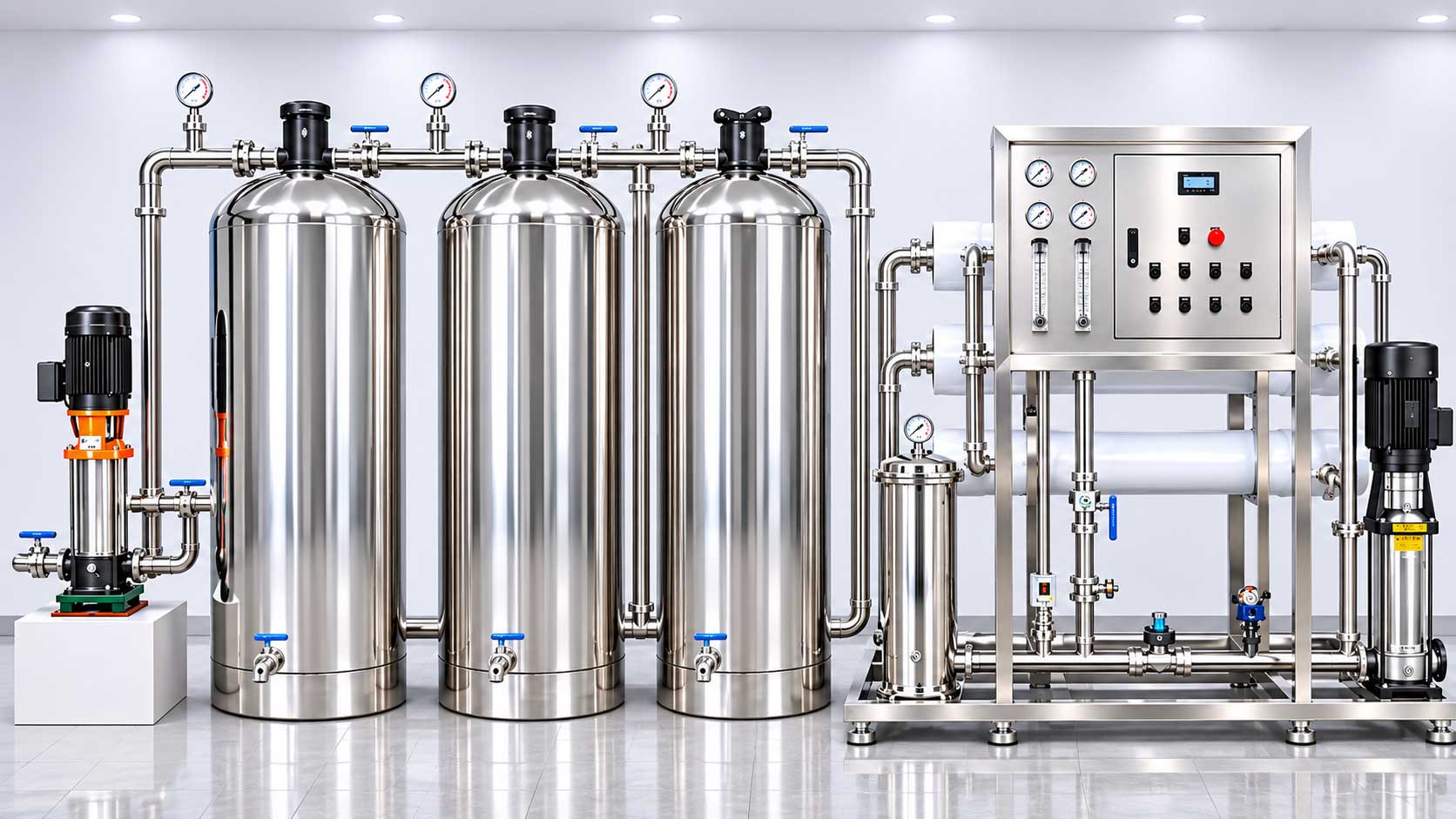
Best Water Engineering (BWE) supplies water-treatment solutions for domestic, commercial and industrial applications. This product page introduces a pharmaceutical reverse osmosis plant concept with stainless-steel process equipment and an integrated treatment arrangement. The illustrated system shows multiple vertical vessels, interconnecting pipes, pumps, pressure gauges, flow indicators, a membrane housing assembly and a control panel. The final plant configuration should be confirmed against the project’s technical requirements before an order is placed.
A reverse osmosis system uses a semi-permeable membrane to reduce many dissolved substances in water. It is commonly considered as one treatment stage in a wider water purification process. However, a pharmaceutical water system is not selected by the RO unit alone. Pretreatment, membrane selection, sanitary design, storage, distribution, monitoring, operation, qualification and validation may all be relevant. BWE can discuss these project requirements with the customer and prepare a proposal based on the information provided.
Important technical note: The image and product name indicate a stainless-steel pharmaceutical RO plant. The separate JOWAY multi-effect water distiller information supplied with the original product brief does not describe this RO plant. Therefore, this description does not claim that the pictured RO unit is a multi-effect distiller, a validated Water for Injection (WFI) generator, or a system certified to USP, EP, JP, ChP, cGMP or 21 CFR Part 11. Such claims must only be published when supported by the exact model’s approved documents, test records and validation package.
Suggested image caption: Stainless Steel Pharmaceutical RO Plant with process vessels, pumps, instrumentation, membrane housings and control panel. Final configuration is project-dependent.
Table of Contents
- Product Overview
- How the Reverse Osmosis Process Works
- Key Features and Potential Benefits
- Main System Components
- Pharmaceutical Applications and Water Grades
- Design and Project Considerations
- Water Quality, Monitoring and Operation
- Product Specifications
- Installation and Maintenance
- Why Choose Best Water Engineering?
- Frequently Asked Questions
- Contact Best Water Engineering
Stainless Steel Pharmaceutical RO Plant – Product Overview
The Stainless Steel Pharmaceutical RO Plant is intended for customers planning an industrial reverse osmosis installation for a pharmaceutical or related process-water project. Stainless-steel equipment can be specified where the project calls for a robust, cleanable and corrosion-resistant construction material. The exact suitability of a particular stainless-steel grade depends on the water chemistry, cleaning regime, temperature, operating conditions and the requirements of the plant owner. The material grade and surface finish should therefore be clearly stated in the approved technical specification.
The illustrated arrangement includes three vertical vessels on the pretreatment side and a skid-mounted RO section. A typical project may use pretreatment vessels to help manage suspended particles, turbidity, hardness or other feed-water characteristics. The precise media and sequence cannot be selected from an image alone. They should be determined from a laboratory analysis of the raw water and the required performance of the downstream RO membranes.
The RO section may include membrane pressure vessels, high-pressure pumping, control instruments and a control panel. These components work together to provide controlled feed pressure and allow the operator to observe relevant operating conditions. The number and type of membrane elements, pump duty, flow range, recovery and final output are engineering decisions that must be confirmed for each project.
For pharmaceutical facilities, selecting an appropriate water-treatment system is an important part of production planning. Different manufacturing processes may have different water-quality requirements. A properly planned water-treatment installation should consider the quality of the source water, the intended application, the required treated-water quantity and the operating conditions of the facility.
How the Reverse Osmosis Process Works
Reverse osmosis is a membrane separation process. In a conventional RO arrangement, feed water is delivered to a membrane under pressure. Water molecules pass through the membrane, while a large proportion of dissolved salts and other rejected substances remain in the concentrated stream. The treated stream is commonly called permeate or product water, while the concentrated stream is called reject or concentrate water.
The quality and quantity of RO permeate depend on several factors. These include feed-water composition, temperature, pressure, membrane type, membrane condition, recovery setting, pretreatment performance and system operation. For this reason, a responsible plant proposal should not promise a fixed output quality or production rate without the necessary feed-water data and design conditions.
1. Feed-Water Assessment
Before selecting an RO plant, the incoming water should be assessed. Useful parameters may include total dissolved solids, pH, hardness, alkalinity, conductivity, turbidity, iron, manganese, silica, microbial indicators and other contaminants relevant to the source and intended use. Not every project requires the same test list. A qualified project team should identify the appropriate analysis based on the source water and the facility’s water-quality target.
Feed-water analysis helps engineers understand the treatment challenges before choosing equipment. For example, water containing high hardness may require a suitable scale-control strategy. Water containing suspended particles may need additional filtration. Source water with different dissolved mineral concentrations may require a different membrane configuration or operating arrangement.
2. Pretreatment
Pretreatment protects downstream equipment and helps create suitable feed conditions for the RO membranes. Depending on the raw-water report, a system may require sediment filtration, multimedia filtration, activated carbon, softening, cartridge filtration, chemical dosing or other treatment steps. These are examples of possible options, not a statement that every listed component is included in this particular model. The final sequence should be selected after reviewing the feed-water analysis and the membrane supplier’s operating limits.
Effective pretreatment can help reduce membrane fouling and scaling risks. Proper filtration and conditioning also contribute to stable operation. The equipment selected for pretreatment should be compatible with the source water and the intended operating conditions of the RO plant.
3. Reverse Osmosis Membrane Separation
After suitable pretreatment, feed water enters the RO membrane section at the designed operating pressure. The membrane separates permeate from concentrate. Proper membrane selection and system design are important for stable flow, salt rejection, recovery and operating life. Membrane brand, model, quantity, size and performance data should be included in the final approved equipment schedule.
Membrane performance should be monitored regularly. Changes in pressure, flow or permeate quality may indicate that the system requires inspection or maintenance. Operators should use the manufacturer’s guidelines and approved operating procedures when reviewing membrane performance.
4. Product-Water Handling
RO permeate may be sent to a suitable storage and distribution arrangement or to additional purification stages, depending on the required water grade. Pharmaceutical facilities should assess the complete water system rather than treating the RO skid as the entire solution. Storage tanks, recirculation, sanitization approach, distribution materials, sampling points, monitoring and control strategy may all need to be considered by the project owner and its qualified engineering or quality team.
The storage and distribution arrangement is especially important when water must be supplied continuously to different manufacturing areas. The design should consider the water demand, distribution distance, operating schedule and applicable quality requirements.
Key Features and Potential Benefits
The following points describe the features visible in the supplied product image and the benefits that may be achieved when the system is correctly specified. Final inclusion, materials and performance must be confirmed in the approved quotation and technical documents.
Stainless-Steel Equipment Arrangement
The illustrated plant uses stainless-steel vessels and process pipework. Stainless steel is often selected for industrial equipment where strength, durability, cleanability and resistance to corrosion are important considerations. The grade should be chosen for the actual water chemistry and operating environment. Customers should request confirmation of the grade, wetted-part list, fabrication details and surface finish rather than assuming a particular grade from appearance alone.
A suitable equipment material selection is important for long-term operation. Material compatibility should be considered in relation to the water characteristics, cleaning chemicals, temperature and operating environment. The final stainless-steel grade should be documented in the approved technical proposal.
Integrated Process Piping
Interconnecting pipework helps link the treatment stages and route water through the system. A well-planned piping arrangement can support accessibility, operation and maintenance. For pharmaceutical projects, the complete design may also need to address drainability, dead legs, hygienic connections, material compatibility and cleaning or sanitization requirements. These details must be reviewed in the engineering drawings and cannot be verified from the product photograph.
Pumps and Pressure Monitoring
The pictured arrangement includes pump assemblies and pressure gauges. Pumps provide the flow and pressure required by the relevant process stages. Pressure indicators help operators observe operating conditions and identify changes that may require investigation. Pump capacity, wetted materials, motor rating, seal arrangement and instrumentation ranges should be matched to the final process design.
Monitoring pressure at suitable points in the treatment line can help operators understand system performance. Regular inspection of pumps, connections and pressure indicators is an important part of a planned maintenance programme.
Flow Indicators and Operator Controls
Flow indicators allow the operator to observe selected process streams. The control panel provides a central location for the controls and instruments included in the final electrical design. Depending on the selected configuration, the control philosophy may include manual controls, automatic sequences, alarms, interlocks and data recording. No PLC brand, remote-monitoring function, electronic-record compliance or data-integrity capability should be assumed unless explicitly listed in the product-specific documentation.
Project-Based Configuration
Pharmaceutical water demand varies between facilities. A plant for a small process area may have different flow, storage and distribution requirements from a multi-shift manufacturing site. A project-based approach helps align the proposed equipment with peak demand, operating hours, available utilities, space, raw-water conditions and the desired quality target. Customers should share their requirements before the final model and price are confirmed.
Main System Components
The exact bill of materials must be taken from the supplier’s approved quotation. The following list explains common sections that may be considered when engineering an industrial RO project:
- Raw-water supply: Provides feed water from the selected source. The source, flow availability and seasonal variation should be assessed.
- Pretreatment vessels: May house selected filtration or conditioning media according to the raw-water report. Media type and vessel specification require confirmation.
- Cartridge filtration: May be installed upstream of the RO membranes to reduce fine particles, subject to the design.
- High-pressure pump: Supplies the pressure required for membrane operation. Its capacity and materials should match the process conditions.
- RO membrane pressure vessels: Hold the membrane elements. The number, size and arrangement are determined by the required production and water quality.
- Pressure gauges: Help monitor pressure at selected points in the treatment line.
- Flow indicators: Help observe selected feed, permeate or reject streams where included.
- Control panel: Provides the operator interface and electrical controls included in the final configuration.
- Product-water storage and distribution: May be supplied as separate or integrated project equipment, depending on the agreed scope.
Not all projects require every component in the same arrangement. The customer should review the process flow diagram, equipment list, piping and instrumentation diagram, electrical drawings and scope-of-supply document before approving the order.
Pharmaceutical Applications and Water Grades
Pharmaceutical production uses water for different purposes, and each purpose may have its own quality requirements. Water used as a utility, for equipment cleaning, for laboratory work or as an ingredient in a manufacturing process may not have the same specification. The plant owner must identify the intended use and the applicable current regulatory and compendial requirements before choosing a treatment system.
A reverse osmosis unit may form one part of a Purified Water treatment train. Depending on the target specification and risk assessment, additional technologies or treatment stages may be required after RO. A pharmaceutical water system may also require appropriate storage, circulation, sanitization, sampling, testing, monitoring and documented operating procedures.
Purified Water Considerations
Where the target is Purified Water, the overall system should be designed around the relevant current pharmacopoeial requirements and the facility’s quality system. A single RO stage does not, by itself, prove that the final water meets a pharmaceutical specification. The complete treatment train and the final water must be assessed using suitable tests, monitoring and documented qualification or validation activities.
Water for Injection Considerations
Water for Injection (WFI) is a distinct pharmaceutical water grade with specific requirements. A standard industrial RO plant should not be advertised as a WFI generator unless the complete system has been specifically designed, documented and demonstrated to meet the applicable requirements. The multi-effect distiller description supplied separately is not evidence that this RO product includes a distillation system or produces WFI. Customers requiring WFI should provide that requirement at the enquiry stage so the appropriate technology and project scope can be evaluated.
Design and Project Considerations
Correct system sizing starts with a clear understanding of the facility’s demand. The daily quantity alone may not be enough. Engineers may also need to know the peak hourly demand, operating shifts, batch schedule, required storage autonomy, simultaneous users and expected future expansion. These details help determine the permeate flow rate, storage volume, pump selection and operating schedule.
Feed-water quality is another critical design input. A borewell, municipal supply, surface-water source and tanker supply can have different characteristics. Even a source that appears clear may contain dissolved minerals or other substances that affect membrane performance. A recent water analysis is therefore a useful starting point for a technical discussion.
Customers should also consider the installation environment. Available floor area, access for replacing filters and membranes, drainage, ventilation, electrical supply, water supply pressure and safe chemical-handling arrangements may affect the layout. The plant should be installed in a location that allows inspection and service access in accordance with the approved drawings and applicable safety practices.
Information to Share for a Project Quotation
- Raw-water source and a recent laboratory water analysis.
- Required product-water grade and intended application.
- Required production capacity, preferably in litres per hour or gallons per day.
- Daily operating hours and expected peak demand.
- Available electrical supply and installation location.
- Required storage tank capacity and distribution arrangement.
- Any customer-specific material, documentation, monitoring or validation requirements.
Providing these details at the enquiry stage can help the supplier understand the project more accurately. It also helps avoid selecting a plant based only on a general product photograph or an estimated capacity.
Water Quality, Monitoring and Operation
Water quality should be verified using suitable sampling and testing methods. Conductivity or total dissolved solids readings can provide useful operating information for an RO system, but they do not establish every aspect of pharmaceutical water quality. The appropriate test plan depends on the water grade, the process use, the system design and the facility’s approved quality procedures.
Operators should follow the equipment supplier’s operating instructions and the facility’s approved procedures. Routine records may include feed pressure, operating pressure, permeate flow, concentrate flow, conductivity, temperature, filter differential pressure and relevant alarm events. The specific parameters and limits should be defined in the final operating documentation rather than copied from another plant.
Membrane performance can change over time due to fouling, scaling, oxidation, unsuitable feed conditions or normal wear. A maintenance plan should define inspection, cleaning, replacement and performance-review activities. Chemical cleaning must only be carried out using procedures and chemicals compatible with the selected membrane and the system materials.
For pharmaceutical use, the water-treatment plant may form part of a controlled quality system. The plant owner is responsible for determining the required qualification, validation, calibration, testing, documentation, change control and ongoing monitoring. BWE should only be considered the supplier of the scope stated in the approved purchase and technical documents; regulatory compliance responsibilities must be agreed and documented clearly.
Stainless Steel Pharmaceutical RO Plant – Product Specifications
The supplied product information confirms the product name and shows an industrial treatment arrangement. It does not provide the numerical design data required to publish a complete technical specification. The following table separates visible or supplied information from details that need confirmation.
| Parameter | Available Information |
|---|---|
| Product Name | Stainless Steel Pharmaceutical RO Plant |
| Treatment Technology | Reverse Osmosis (RO) |
| Visible Equipment | Vertical vessels, pumps, piping, gauges, flow indicators, membrane housings and control panel |
| Vessel Material Grade | To be confirmed |
| Pipe Material and Grade | To be confirmed |
| Production Capacity | To be confirmed according to project demand |
| Membrane Brand and Model | To be confirmed |
| Number of Membrane Elements | To be confirmed |
| Feed-Water Requirement | To be determined from raw-water analysis |
| Recovery Rate and Permeate Quality | To be confirmed by the approved design and operating conditions |
| Pump Brand, Motor Power and Electrical Supply | To be confirmed |
| Automation and Control Functions | To be confirmed |
| Storage Tank and Distribution System | Scope to be confirmed |
| Warranty and After-Sales Service | As stated in the quotation and warranty document |
Explore more water purification and treatment solutions from
Customers should request a final technical datasheet before purchase. The approved datasheet should identify the design capacity, operating conditions, materials of construction, membrane details, pretreatment arrangement, instruments, electrical requirements, scope of supply and exclusions. This helps both parties understand exactly what is included in the project.
Installation, Commissioning and Maintenance
Installation should follow the approved general arrangement drawing, piping layout, electrical drawings and equipment instructions. Before commissioning, the installation team should check the foundation or support, pipe connections, valves, electrical protection, earthing, drainage and availability of the required utilities. Any chemical preparation or disinfection activity should follow a documented procedure suitable for the selected materials and intended application.
Commissioning normally involves checking the equipment installation, flushing suitable lines, verifying instruments, confirming pump rotation, checking for leakage and recording initial operating values. The exact commissioning protocol and acceptance criteria should be agreed in the project documents. Performance acceptance should be based on defined feed-water conditions and agreed test methods, not on an informal observation alone.
Preventive maintenance helps protect equipment reliability. Depending on the final configuration, maintenance may include cleaning or replacing pretreatment media, changing cartridge filters, inspecting pumps and seals, checking valves and instruments, monitoring membrane performance and reviewing electrical components. Replacement intervals should be based on actual operating conditions, supplier guidance and recorded performance trends.
For a pharmaceutical facility, maintenance activities may also require controlled documentation, approved procedures and quality-team review. Any modification to the treatment arrangement should be assessed under the facility’s applicable change-control process. BWE can discuss the agreed service scope and support requirements during project planning.
Why Regular Maintenance Matters
Regular inspection helps identify developing operational problems before they become major interruptions. A blocked filter, abnormal pressure drop, damaged seal or change in membrane performance may affect the operation of the treatment system. Keeping appropriate operating records makes it easier to compare current readings with previous performance and identify when inspection or service is required.
Customers should maintain a record of filter replacement, membrane cleaning, instrument calibration, maintenance work and any modifications made to the system. The maintenance schedule should be based on the actual equipment supplied, the manufacturer’s recommendations and the facility’s operating requirements.
Why Choose Best Water Engineering?
Best Water Engineering (BWE) works with water purification and treatment products for domestic, commercial, and industrial requirements. A pharmaceutical RO project needs more than a product name: it needs a clear process requirement, suitable raw-water information, a defined scope, and a technical proposal that the customer can review.
When contacting BWE, customers can discuss their water source, required capacity, application, installation location, and any project documentation needs. This information helps the team understand the application and identify which technical details must be confirmed before a quotation is prepared.
BWE’s broader water-treatment experience includes water purification products and industrial treatment solutions. The scope for each project should be stated individually. Product design, supply, installation, commissioning, qualification support, validation documentation, and ongoing maintenance should not be assumed to be included unless they are specifically listed in the quotation or contract.
Professional Water Purification Solutions
Every water-treatment project has its own requirements. The raw-water source, target water quality, flow demand, available space, and operating schedule can influence the final plant design. BWE encourages customers to provide clear project information so that the proposed solution can be reviewed against the actual application rather than relying on a generic configuration.
Support Before Purchase
Before placing an order, customers should review the technical proposal, process flow diagram, equipment list, material specifications, utility requirements, warranty conditions, and delivery scope. They should also confirm what site preparation and customer-supplied utilities are required. A clear document review helps reduce misunderstandings during installation and operation.
Support After Purchase
After-sales support should be agreed according to the project scope and the customer’s operational needs. Customers should ask which services are available, how service requests are handled, which consumables are recommended, and what maintenance records should be retained. The exact service commitment should be documented in the quotation or service agreement.
Frequently Asked Questions
1. What is a Stainless Steel Pharmaceutical RO Plant?
It is an industrial reverse osmosis water-treatment system planned for pharmaceutical or related process-water applications. The final design depends on the feed-water quality, required water grade, production demand, and facility requirements.
2. Can this RO plant be used in a pharmaceutical factory?
It may be suitable as part of a pharmaceutical water-treatment project, subject to engineering review and confirmation of the required water grade. The complete water system, not only the RO skid, must meet the facility’s approved requirements.
3. Does an RO plant automatically produce Purified Water?
No. RO can be an important treatment stage, but final water quality depends on the complete treatment train, operating conditions, storage, distribution, monitoring and appropriate testing. Compliance must be demonstrated for the complete system and intended use.
4. Does this product produce Water for Injection (WFI)?
WFI production is not confirmed for this product. A standard RO plant should not be described as a WFI generator without product-specific design documents and evidence that the complete system meets applicable requirements. Please state the WFI requirement during your enquiry.
5. What is the production capacity of this Pharmaceutical RO Plant?
The capacity has not been supplied in the current product information. It should be selected after reviewing the required hourly or daily demand, feed-water analysis and design conditions. BWE can discuss the project requirements before preparing a quotation.
6. Which stainless-steel grade is used in the plant?
The stainless-steel grade is not specified in the available information. Customers should request the exact grade and wetted-part material details in the approved technical datasheet and quotation.
7. What information is needed to calculate the price?
Useful information includes the required capacity, raw-water source and analysis, target water grade, membrane configuration, pretreatment requirements, materials, automation scope, storage and installation requirements. The final price should be based on an agreed technical scope.
8. How can I request a quotation from Best Water Engineering?
Contact BWE through the WhatsApp numbers or website listed below. Share your required capacity, water source, intended application, and available water analysis so the project can be reviewed more accurately.
Contact Best Water Engineering (BWE)
For information about the Stainless Steel Pharmaceutical RO Plant, project consultation, or a quotation, contact Best Water Engineering. Please share your raw-water report, required capacity, intended water grade, and installation details when making an enquiry.
Company: Best Water Engineering (BWE)
Tagline: Best Water Better Life
Address: 29/20 Circular Road, Dainik Bangla More, Motijheel, Dhaka, Bangladesh.
WhatsApp: +880 1898-942229
WhatsApp: +880 1898-942230
Website: https://bestwaterbd.com/
Best Water Engineering – Professional Water Purification Solutions for domestic, commercial, and industrial water-treatment requirements.

Reviews
There are no reviews yet.